Interview with Donna Giada Ruspoli and Dinko Fabris on Rai – Radio 3
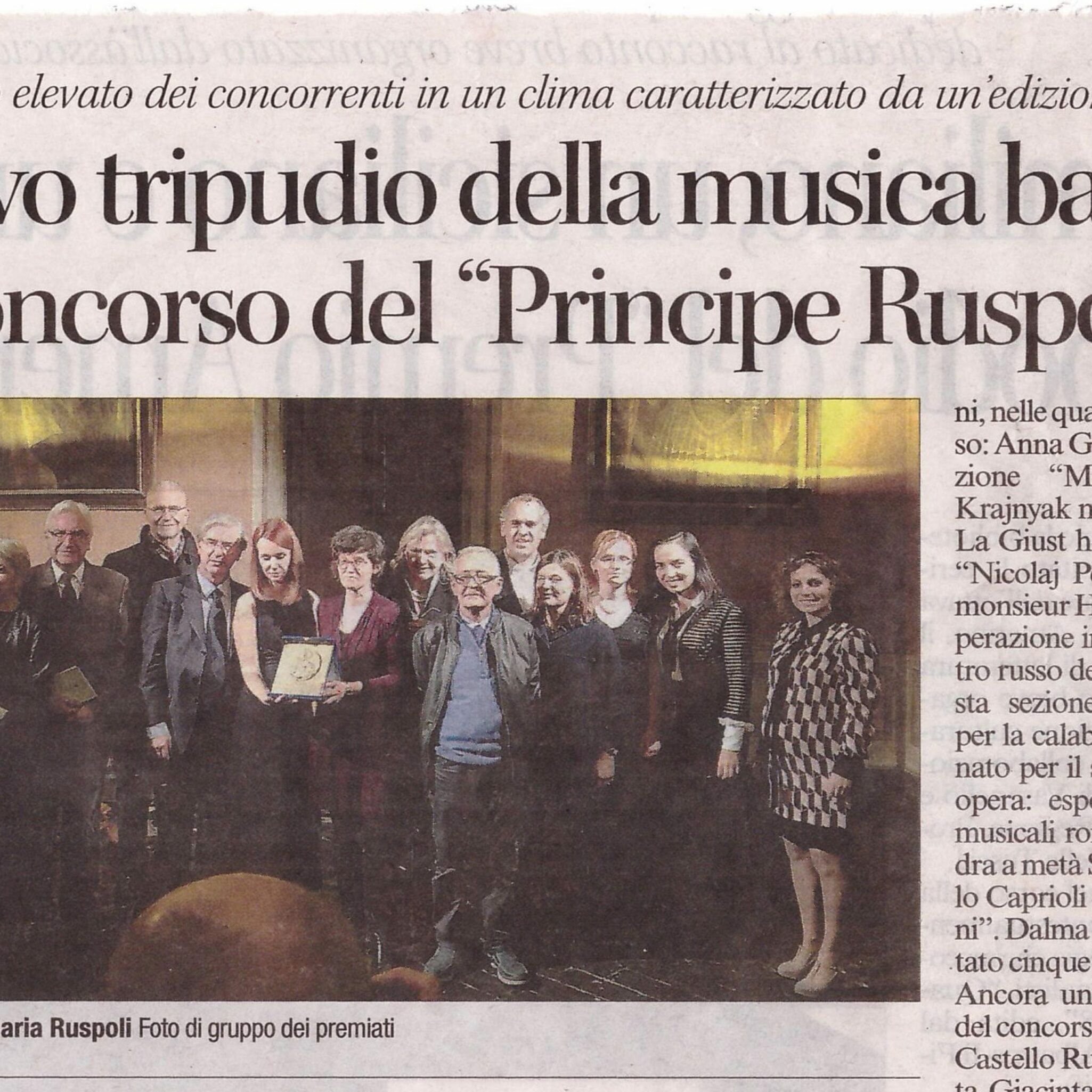
We are very pleased to share the transcription of the interview broadcast on Rai – Radio 3 on the occasion of the fifth edition of our Prize. At the station’s microphones, the patron of the event, Donna Giada Ruspoli, and Professor Dinko Fabris, a member of the musicology jury, talk about the emotions, discoveries, and results of this recently concluded edition.
Interview Transcription:
Host: It’s beautiful because we know absolutely everything about Georg Friedrich Handel’s Resurrection. It’s the Italian Handel, this recording made some years ago by Christopher Hogwood is truly wonderful. And, as I was saying, we know everything, we know everything also because Handel was a guest of Prince Francesco Maria Ruspoli. In Vignanello, where there is this splendid property of the family, the Ruspoli family, and we are talking about it because this afternoon the fifth international baroque music competition, named after Prince Francesco Maria Ruspoli, concluded with the proclamation of the winners. This edition was divided into two sections, baroque singing and musicology. And we talk about it first of all with Giada Ruspoli. Good evening and have a good Sunday.
Giada Ruspoli: Good evening, good evening.
Host: Here is the soul of this competition, the soul of this study center, the study and research center named after Santa Giacinta Marescotti. And also with Dinko Fabris who is a musicologist and member of the scientific committee that made the choices regarding musicology, above all. Good evening Dinko Fabris.
Dinko Fabris: Greetings to all listeners.
Host: Good evening. So, I will naturally first give the floor to Giada Ruspoli, I ask you to illustrate, in general terms, what this fifth edition of this important international competition was like.
Giada Ruspoli: Well, good evening, this year we had the singing section, coordinated as artistic director by Giorgio Monari, Professor Giorgio Monari, who is also the coordinator and scientific head of the musicology section. And so, among the competitors, by the way this year various Italians were in the finals with two foreigners, a Canadian and a Slovak. And a wonderful young man won, Aurelio Schiavoni from Taranto.
Host: Ah, here, because I have in front of me, from your website which I remember is www.centrostudisgm.com, where there are, apart from the wonderful photographs but also obviously all the details, there were the names of the six finalists. And so, Flavia Benedetti, Alice Borciani, Luca Cervoni, from Canada Rebecca Dowd, Aurelio Schiavoni, indeed, from Taranto, and Matus Simko from Slovakia. So we have the name of the winner, who comes from Puglia, therefore, Aurelio Schiavoni. Well, this is also a good sign perhaps for our country.
Giada Ruspoli: Yes, and the winner of the musicology section was Peter Poulos, who comes from Cincinnati, Ohio.
Host: Well, can I at this point call on Dinko Fabris and ask him about this choice by the commission he was part of?
Dinko Fabris: First of all, I would like to specify that there are so few musicology competitions, very few competitions dedicated to baroque music in our country, it is truly precious to have a form of patronage that encourages musicology in all its forms. We have, among other things, opened this up to the whole world; already last year the winner was a Spaniard, Ana Lombardía. This year we had to acknowledge that the work presented by Peter Poulos was truly of great interest because he presented us with an unpublished research on Simone Molinaro, who was a Genoese musician at the end of the sixteenth century, very little appreciated, but this year particularly important because he was the publisher of the first score of the madrigals of Gesualdo da Venosa, or rather of Venosa, as we say now, Prince of Venosa. And the case of Molinaro is fantastic because he found a score of madrigals by Molinaro himself that had not been discussed, comparable therefore to that of Gesualdo. A truly important contribution, in short.
Host: Well, thank you. So, to Dinko Fabris I hope you can settle in a different place because we have some quality problems with the phone call. I would instead like to ask another question to Giada Ruspoli. How would you describe in one minute this very important reality, as Dinko Fabris mentioned earlier, the patronage, the study and research center named after Santa Giacinta Marescotti, in short, your study and research center?
Giada Ruspoli: Well, in the 1700s Francesco Maria Ruspoli was truly a great lover of music, he is an important figure in this sense because he hosted the major composers of the baroque era. And in fact we opened with the music of the resurrection that resounded in your rooms. Exactly. So it was, then since I live half the year in Brazil, I saw that young musicians were studying, indeed, Francesco Maria Ruspoli. And I thought, if they study him on the other side of the world, here in Vignanello we must do something. And luckily, with the collaboration of professors who truly assisted me, we set up these sections of musicology, singing and instruments, which we are now carrying forward every year.
Host: What are the projects, are there projects, is there something you can anticipate that we will naturally follow after this fifth edition?
Giada Ruspoli: Well, next year the appointment is always the first weekend of October, because among other things it is close to Saint Francis and we in the family have Francis repeating. Then Santa Giacinta was Franciscan and was born here, therefore the study center is called Santa Giacinta Marescotti and next year will be the violin.
Host: Here, so we will have a section dedicated to the violin and always musicology?
Giada Ruspoli: Always, always musicology because research is very penalized and in our small way we really want to make an effort on this, yes, yes, yes.
Host: Well, I would at this point like to briefly call on Dinko Fabris again, are you still there? Hello? No, nothing, he’s not there. No, because I was interested… Well, I’ll address it anyway with Mrs. Giada Ruspoli. Dinko Fabris was saying earlier that in fact musicology does not get all the attention it deserves, perhaps because it is also a science born in relatively recent times. So your, it is your intention, in short, to continue on this line, which has also given you satisfaction also because you have allowed, as in the case of this year, indeed, an important discovery like that of Simone Molinaro, of this text.
Dinko Fabris (returned): Yes, because in reality our restricted committee, of which Professor Manuel Carlos De Brito from Lisbon is also a member besides Monari and me, favors the arrival of, even of other finalists not only the winner to the publication of essays in what we have called “Miscellanea Ruspoli”. A publication that then travels the world and therefore also allows them to make themselves known to people who can thus know what they are doing. In the future Mrs. Giada Ruspoli has, among other things, wonderful ideas, she is a person of great human energy, she thinks of being able to take the Ruspoli competition further, even across the ocean, but we will perhaps talk about these things again when everything is more mature. There are good international prospects.
Host: I seem to have understood that Brazil, in short, could be a connection. Good. Thanks to Dinko Fabris and Donna Giada Ruspoli for being with us.
Giada Ruspoli: Hello? Yes, here it is. Here we are, here. I was saying goodbye and thanking you and continue to keep the flag of musical patronage flying high. Yes, then music helps us all to be better, so there is a need for it, in short. Thanks a lot. Thank you.
Host: Have a good Sunday. So we salute this international competition, this fifth edition of the competition named, indeed, after Prince Francesco Maria Ruspoli, again with a piece from Handel’s resurrection.