Handel and Rome – On the third centenary of the composer’s stay in Italy
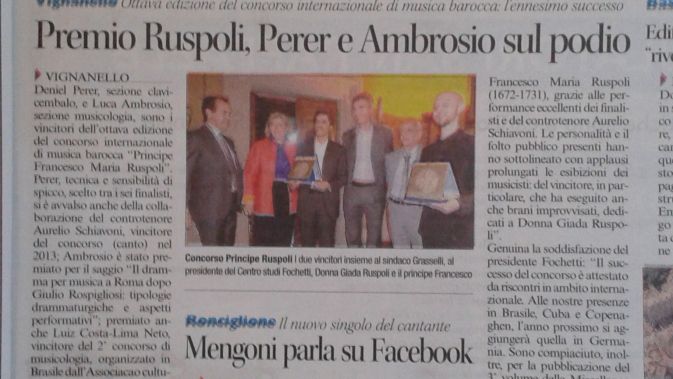
We share this precious clipping from L’Osservatore Romano dated February 11, 2018. The article, written by Prof. Warren Kirkendale, anticipates the presentation of Ursula Kirkendale’s book and celebrates the historical bond between Handel and the Ruspoli family, proudly mentioning the winners of our Competition. This specific archival copy also bears a curious handwritten note at the top. Below is the translation of the text.
Article Text:
Cantatas for Ruspoli The book by Ursula Kirkendale Georg Friedrich Händel, Francesco Maria Ruspoli e Roma (Lucca, Libreria Musicale Italiana, 2017, pages xxv + 230, 30 euros) will be presented on February 12 at 5:00 pm at the Patristic Institute Augustinianum in Rome. The book meticulously reconstructs, thanks to documents discovered in the Vatican Secret Archives, Handel’s activities in Rome between 1706 and 1708. After the introduction by Giorgio Monari, speeches are planned by Johann Herczog and Warren Kirkendale, who will speak about the music and art history research conducted by his wife Ursula, who passed away in 2013, particularly on J.S. Bach’s Musical Offering and Giorgione’s Tempest. A concert of cantatas composed by Handel for Francesco Maria Ruspoli will follow. The program includes Ninfe e pastori, Sento là che ristretto, Stanco di più soffrire. Performing will be the contralto Dalma Krajnyák, Deniel Perer on the harpsichord, and Giordano Antonelli on the cello. Dalma Krajnyák and Deniel Perer are the winners of the Prince Francesco Maria Ruspoli international competition for baroque music and musicological studies. From the book, we publish excerpts of the preface.
On the third centenary of the composer’s stay in Italy
Handel and Rome
by WARREN KIRKENDALE
Handel’s stay in Italy represents one of the most interesting chapters in the history of music and has long fascinated scholars, particularly those from beyond the Alps. The essays published in this volume provide, among other things, an overview of the publications that preceded them, and in the preface, nothing remains but to comment on what the subsequent reactions have been. A book like this, which reprints almost exclusively original information about a great master, discovered by the author a long time ago, can be considered unique today. Before the publication of The Ruspoli Documents on Handel in 1967, almost nothing was known about Handel’s stay in Rome or the fundamental role of Francesco Maria Ruspoli as a patron in the history of music. This was already emerging with the reconstruction carried out for the first time, by the same author, in the 1966 book on Antonio Caldara (Handel’s successor at the Ruspoli household). The essays now translated into Italian, as the first and third chapters of this volume, are among the most cited works in the literature on Handel, immediately since their first publication. Among the most welcome effects was also the founding of the Francesco Maria Ruspoli International Competition for musicians and musicologists in 2009 and the Miscellanea Ruspoli series in 2011 to support musicology and Italian baroque music, which have acquired, in a few years, an international reputation. It is an excellent private initiative at a time when the state does very little for culture.
Another valuable consequence is that masterpiece which is the 45-minute documentary Handel in Rom, shot by Olaf Brühl (Berlin) and broadcasted by the Zweites Deutsches Fernsehen for the first time on December 24, 2006, exactly on the third centenary of Handel’s arrival in the eternal city – it was also seen by the music-loving Pope Benedict XVI, and many other times thereafter, such as, among others, during the Hallische Händel-Festspiele and at the German Historical Institute in Rome. Since this city with its palaces, churches, gardens, sun, and the colorful life of its streets is a paradise for photographers, and since Handel composed much of his best music right here, Brühl, a great friend of Rome and Handel, was able to secure an excellent photographic work and a magnificent musical selection (with only two exceptions: the two countertenors and the trivial final chorus of Rodrigo, the work of a beginner).
Also on the occasion of the third centenary of Handel’s arrival in Rome, no fewer than two conferences on the subject took place in this city, over the span of a few days, at the German Historical Institute and the Accademia di Santa Cecilia. Information has emerged on Handel’s environment and contemporary composers in Rome, but no new biographical data, no new documents on Handel. The same goes for a very recent volume of essays on Roman baroque cantatas. It seems that the sources have already been exhausted, with the exception of the diary of Prince Anton Ulrich of Saxe-Meiningen, brought to light only in 2009 by Rashid S. Pegah and used extensively by Juliane Riepe in 2013. This is the only new archival document of any substance on Handel’s stay in Italy to appear since Ursula Kirkendale’s publications.
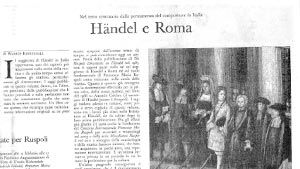
Image Caption: Alessandro Piazza, Reggimento Ruspoli (detail with Handel and other musicians, 1708-1709).